Trang chủ Đăng nhập Check mail
TIN PHÒNG KHÁM BỆNH BS PHÚC
   Chúc mừng năm mới Ất Mùi

Tết đến Xuân về, Phòng khám bệnh Bs Phúc kính chúc Quý bệnh nhân, đồng nghiệp, bạn bè thân hữu năm mới đại cát đại lợi, Phúc như đông hải mãi trường lưu, Lộc đến vinh hoa phú quý về, Thọ tỷ nam sơn tùng bách lão.


...::Chi tiết::...

   Tin liên quan
  HAPPY WESTERN NEW YEAR 2015!(1/1/2015)
  CHÚC MỪNG NĂM MỚI GIÁP NGỌ(28/1/2014)
  Đón năm mới Giáp Ngọ 2014(17/1/2014)
  Thanks Giving Day 2013(3/12/2013)
  CHÚC MỪNG NĂM MỚI QUÝ TỴ(21/1/2013)
TIN Y KHOA
   WHO cảnh báo về chứng bệnh giống bệnh SARS

(WORLD HEALTH ORGANIZATION)

Tổ chức Y tế Thế giới WHO cho biết một người đàn ông Qatar lâm bệnh nặng tại London được đưa vào bệnh viện sau khi cho thấy triệu chứng giống như vi rút bệnh SARS.


...::Chi tiết::...

   Tin liên quan
  Tăng viện phí tại cơ sở y tế nhà nước từ 02/2012(21/3/2012)
  Phòng dịch chủ động, không nên hoang mang(17/6/2009)
  WHO vừa nâng mức báo động dịch cúm lợn từ cấp 4 lên 5.(30/4/2009)
  Tìm ra vaccine chống vi khuẩn E. Coli(17/4/2009)
  Gãy dương vật(8/3/2009)
Lỗi khong thể load XML: A name was started with an invalid character. Error has occured while trying to process http://rss.news.yahoo.com/rss/health
Please contact web-master
  TIN XÃ HỘI
Lỗi khong thể load XML: A semi colon character was expected. Error has occured while trying to process http://dantri.com.vn/Sukien.rss
Please contact web-master
Lỗi khong thể load XML: A semi colon character was expected. Error has occured while trying to process http://www.dantri.com.vn/Thegioi.rss
Please contact web-master
CÁC TIN VẮN KHÁC
   U.S. ambassador to Greece Guilfoyle resigns after alleged misconduct

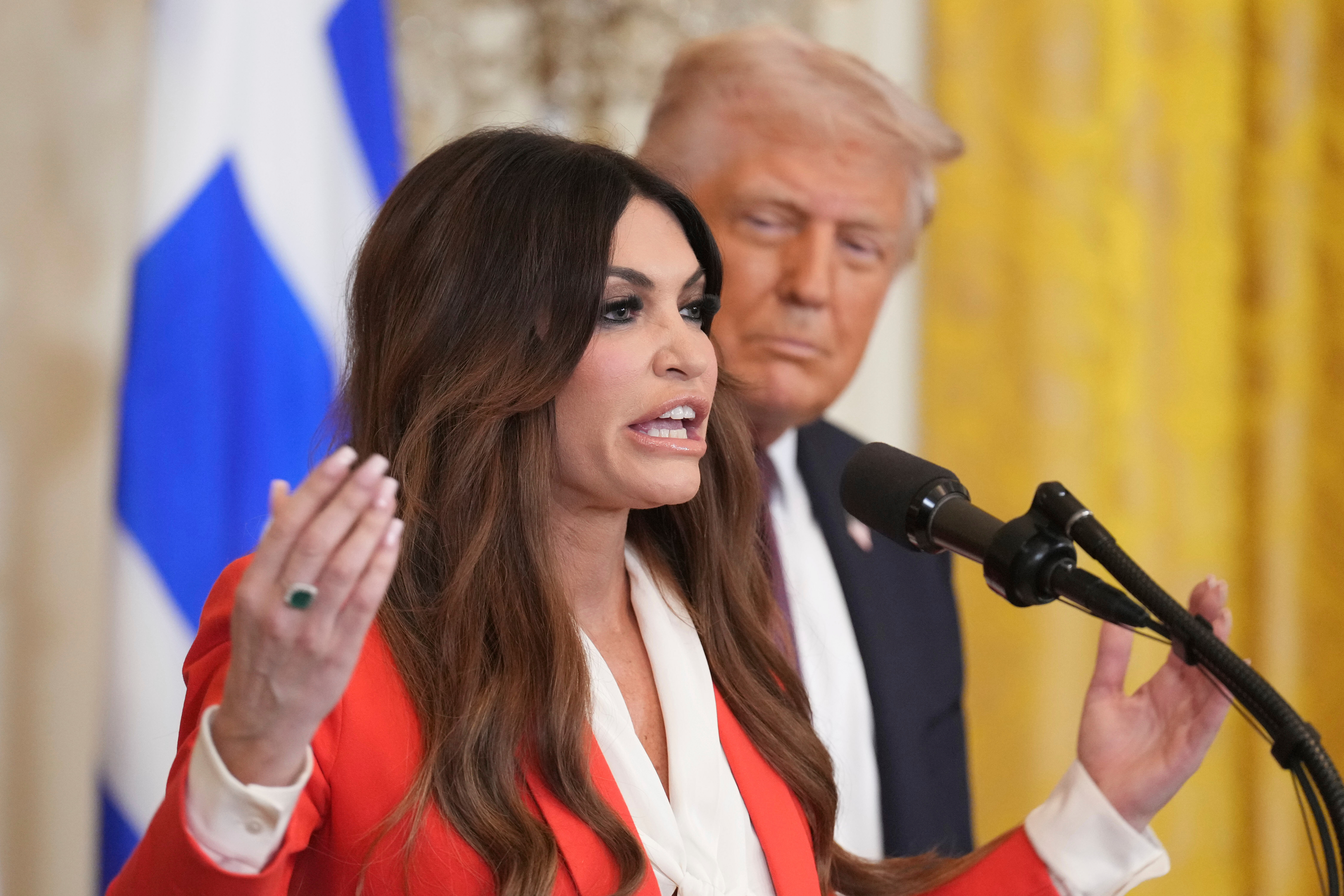
Kimberly Guilfoyle, the U.S. ambassador to Greece, resigned on Tuesday amid allegations of improper conduct while denying the claims and vowing to “vigorously defend” herself.

In a lengthy post on her personal X account on Tuesday morning, Guilfoyle thanked President Trump and Secretary of State Marco Rubio for “entrusting me with the extraordinary privilege of representing the greatest country in the history of the world.”

Guilfoyle also denied the "recent allegations" against her.

"These allegations are false, and I intend to vigorously defend my name, my reputation, and my integrity," Guilfoyle wrote. "I have dedicated my professional life to fighting for justice, standing up for what is right, and defending the values that make America exceptional. I will not allow false accusations to define my decades of public service."

Earlier Tuesday, Katie Zacharia, the new White House press secretary, announced during her first briefing that the administrstion had asked Guilfoyle to resign.

"We have asked Ambassador Guilfoyle to resign," Zacharia said when asked about the status of her employment in Athens. "She has been a wonderful asset to the team and we wish her well."

Kimberly Guilfoyle speaks as President Trump listens at a Greek Independence Day reception at the White House in 2025.
AP Photo/Jacquelyn Martin

The Wall Street Journal reported last week that Guilfoyle asked a Trump donor to pay off a $100,000 American Express credit card bill ahead of her confirmation as ambassador in exchange for access to administration officials.

Guilfoyle, 57, was confirmed as U.S. ambassador to Greece in September 2025. According to the Journal, as Guilfoyle was preparing for her Senate confirmation hearings, she asked Eric Deters, a former Kentucky gubernatorial candidate and Trump donor, to send a $100,000 wire transfer to help pay down her American Express account "in a way that wouldn't leave a paper trail."

The report cited text messages between Guilfoyle and Deters.

"Honey please I need you to get this done for me today," she texted Deters, according to the Journal.

After the report was published, Deters told NBC News that he viewed Guilfoyle’s request as a “quid pro quo.”

"She was so desperate for that $100,000. It was a quid pro quo," Deters said. "She said I could ask her for anything and everything in Trump world. There was no request too big.”

A lawyer for Guilfoyle initially told the Journal that she disputed the authenticity of the messages. In a statement released late Sunday, her attorneys denied that she had done anything wrong and said she was seeking payment for appearance fees that predated her ambassadorship.

On Monday, Trump told reporters that he was considering firing Guilfoyle, a former Fox News host who served as an adviser to his presidential campaign and was the fiancée of Donald Trump Jr.

"Well, we're looking at it," Trump said before leaving for an Ohio campaign rally. "Yeah, we're not happy."

This is a breaking news story. Refresh this page for updates.

This article originally appeared on Yahoo News at https://www.yahoo.com/news/us/article/white-house-asks-for-kimberly-guilfoyles-resignation-as-us-ambassador-to-greece-after-report-she-asked-donor-to-pay-her-100k-credit-card-bill-154738704.html
Tue, 13 Oct 2026 16:08:55 +0000
   Trump's midterm challenge grows as gas prices rise and his approval falls
Graphic showing a stylised chart with purple bar graphs and two red trend lines moving in opposite directions across the image. A black-and-white close-up portrait of Donald Trump fills the right side of the frame. The image uses a dark purple background.
[BBC]

Americans head to the polls on 3 November to decide how the rest of Donald Trump's presidency will play out.

Thousands of races are taking place across the US, at different levels of government. But the main event for voters will be electing members of the House of Representatives and the Senate, the two chambers that make up Congress.

Both of them are currently controlled by the Republicans, the president's party. The success or failure of Trump's final two years in office could rest on the outcome.

Here's our visual guide to where the battle for power will be won and lost - from approval ratings, to key races and issues and the huge amount of money being spent.

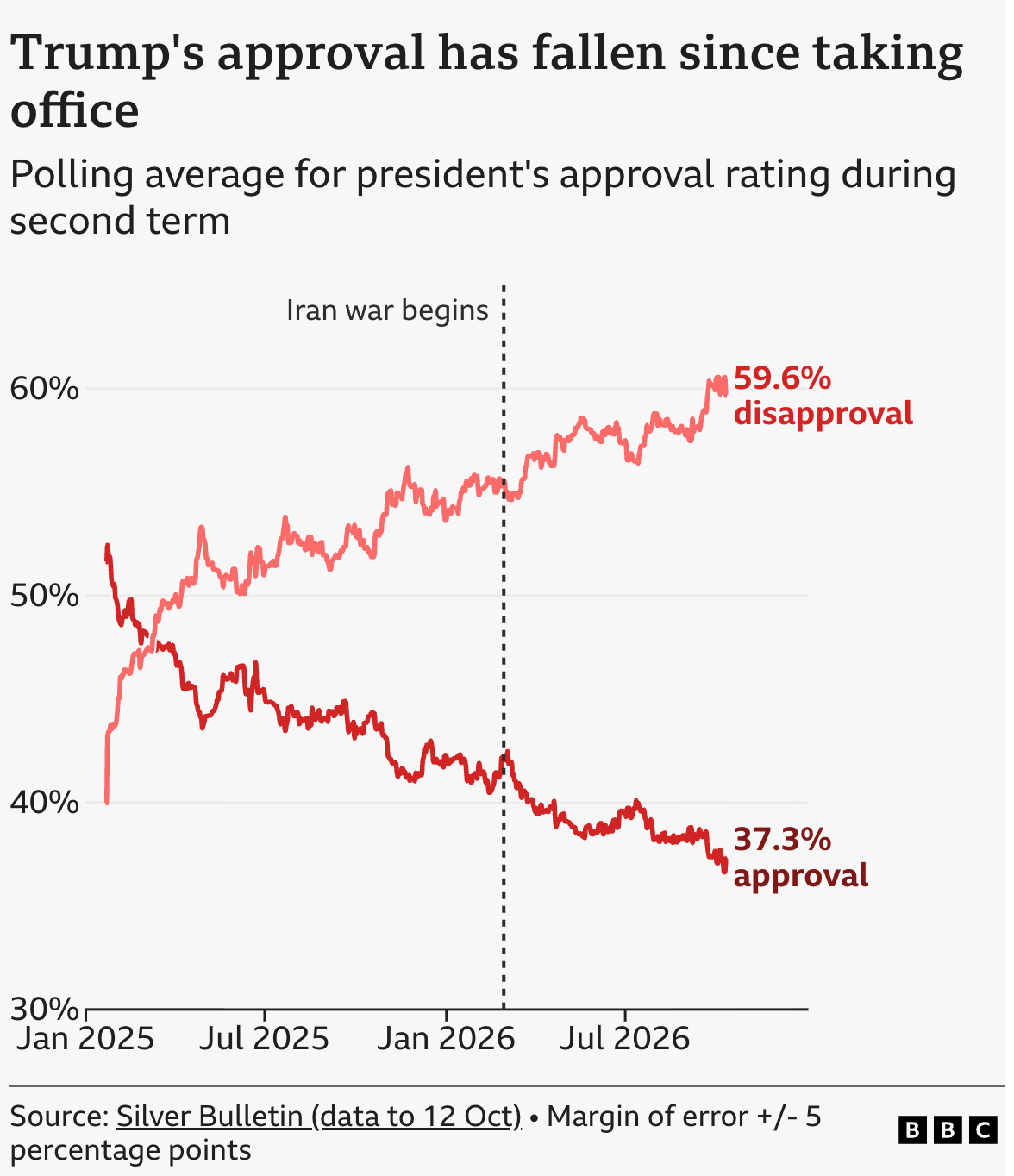
One of the reasons the opposition Democrats have a chance to take back Congress is the president's low approval rating, which is a good indicator for how well his party could perform.

He began his second term as president with an approval rating of just over 50%, according to polling resource website Silver Bulletin, but it quickly fell into the 40s.

Trump's approval has fallen since taking office
BBC

It was hovering around 42% when Trump decided to launch air strikes with Israel against Iran at the end of February this year but it fell below 40% shortly afterwards. It is currently sitting at about 37%.

Eight years ago, Trump's approval rating was significantly higher at this point in his first term, at 43%. Joe Biden's at the same point in his term was at 40%. In both cases, the sitting president lost control of the House in the midterms but kept hold of the Senate.

But Trump's poor ratings help explain why Democrats are hopeful of winning both chambers of Congress and why they are setting their sights on states that Republicans have won consistently in recent years.

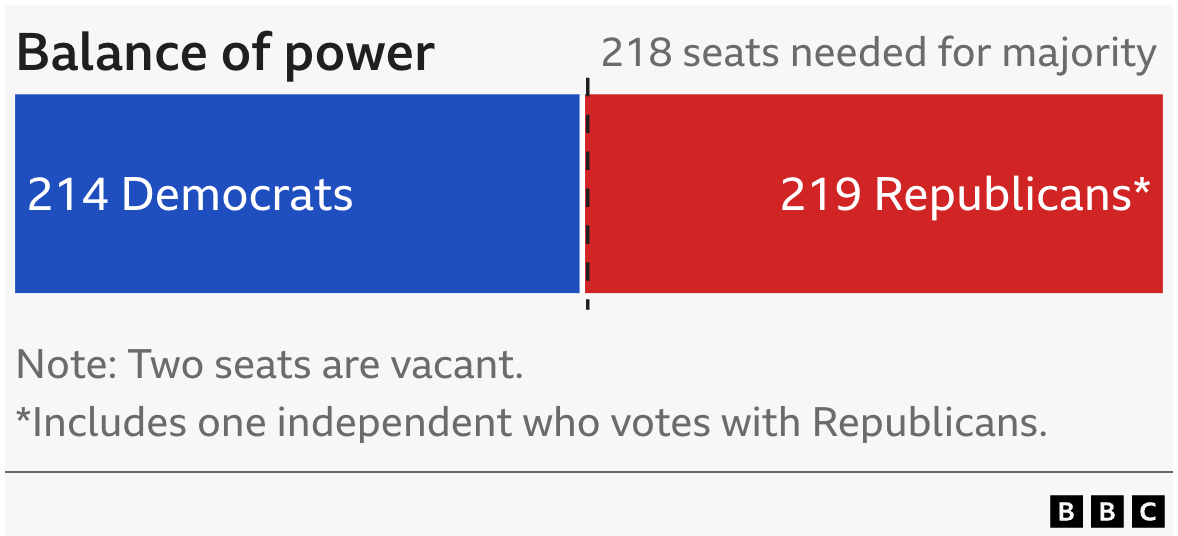
The current Republican majority in the House of Representatives, the lower chamber, is as thin as it gets - they have 218 representatives, which is the exact number needed to have control, plus one independent who votes with them.

The battle for the House

Members of the House serve a two-year term so all 435 seats are up for election in November.

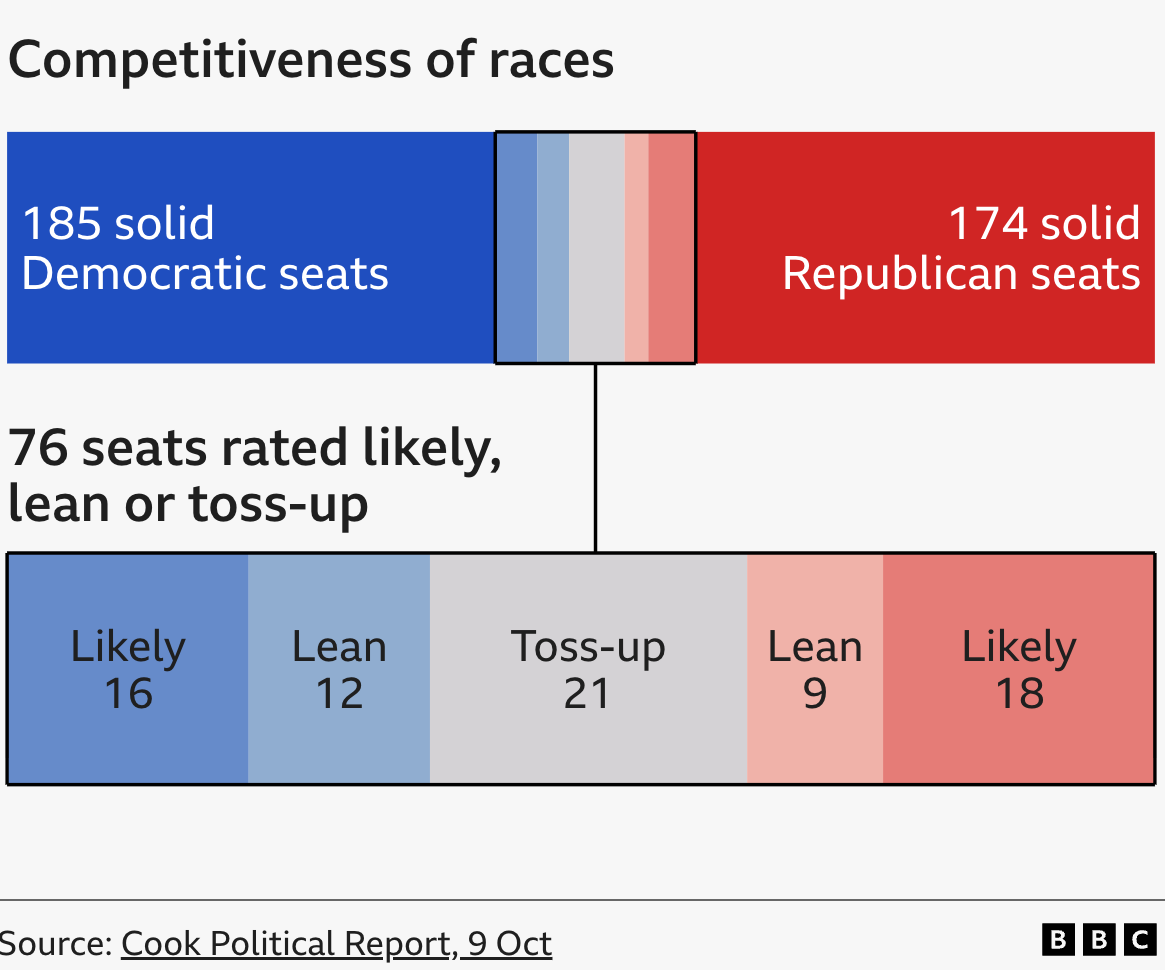
But most districts are not considered competitive because the party that holds them has such solid support that there is only one likely winner.

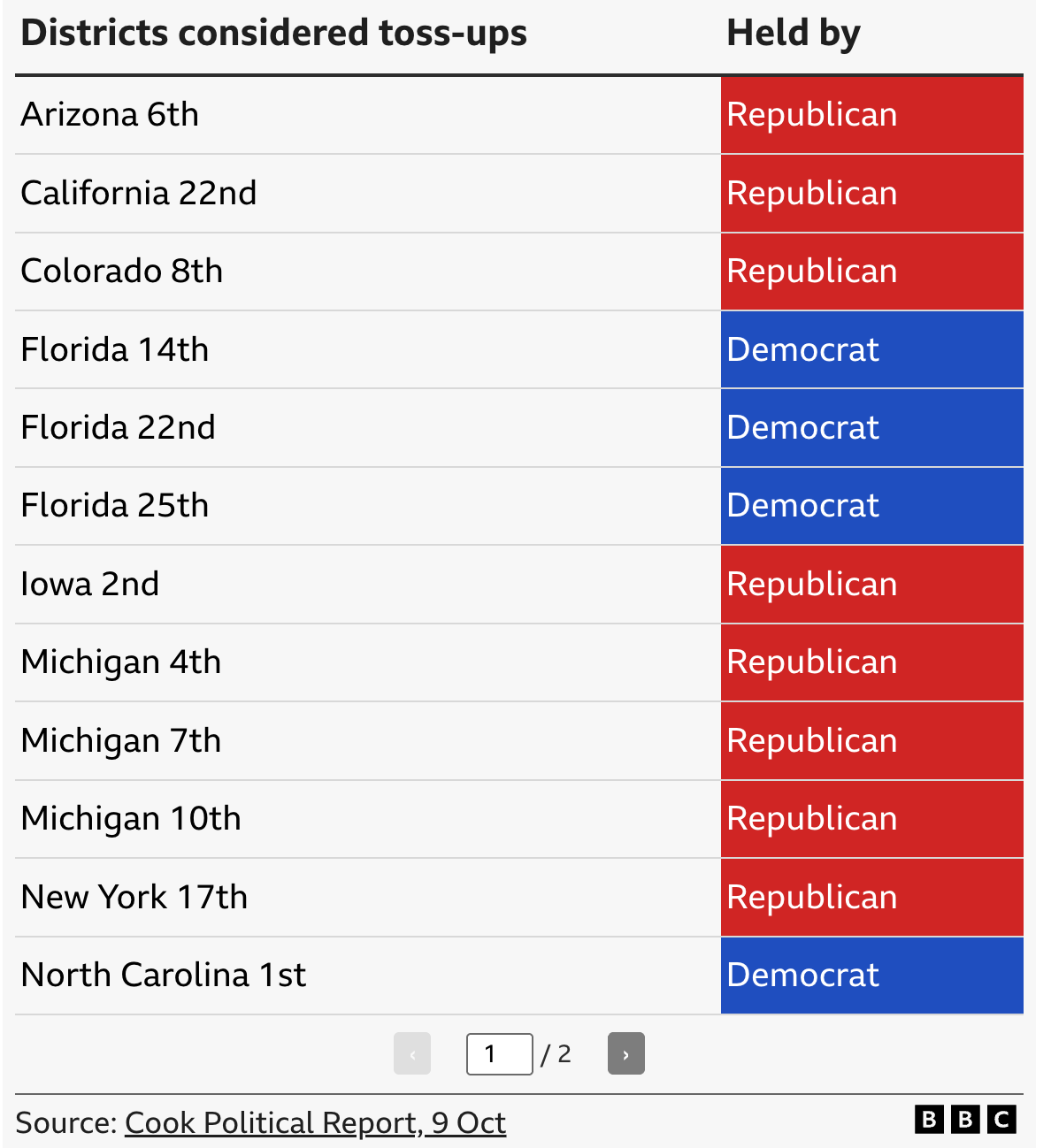
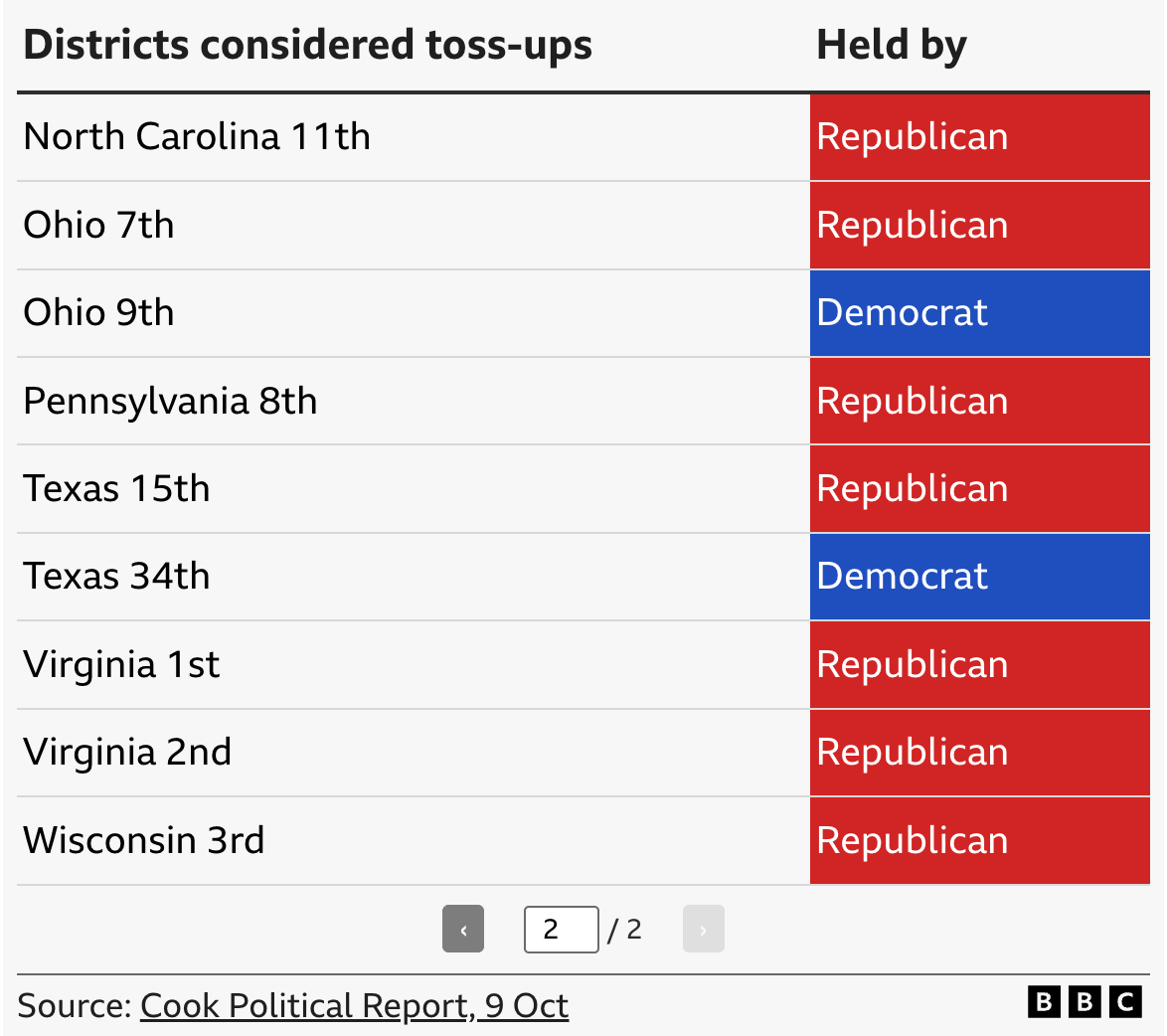
The Cook Political Report, which analyses campaigns and elections, suggests that just 21 districts are "toss-ups" that could be won by either party.

Competitiveness of races

Of those 21 toss-ups, 15 are currently held by Republicans and six by Democrats. If the Democrats win five of those on top of 28 districts classed as likely or leaning Democratic, they will win the House.

Districts considered toss-ups

Historically, the midterms see a high number of seats changing hands in the House, usually in a protest against the White House. The average number lost by the president's party is 27, according to data going back to 1934. Of those 23 elections, the president's party has only made gains in three.

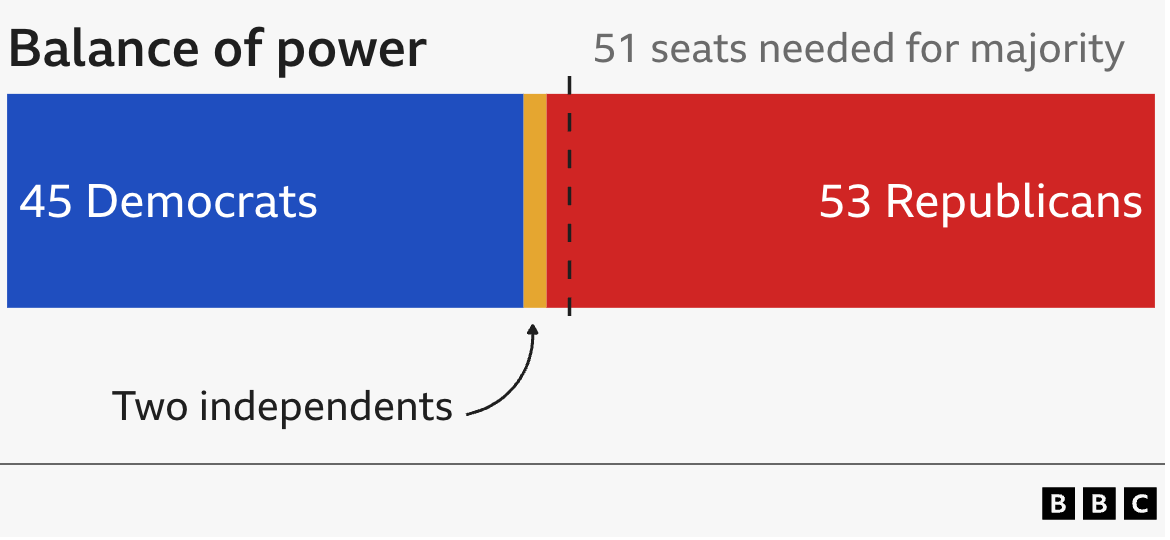
The Republicans have a slightly stronger hold on the Senate. They hold 53 of the 100 seats while the Democrats have 45 and two independents who also vote with them.

The battle for the Senate

Members of the Senate serve six-year terms so roughly a third are up for election every two years.

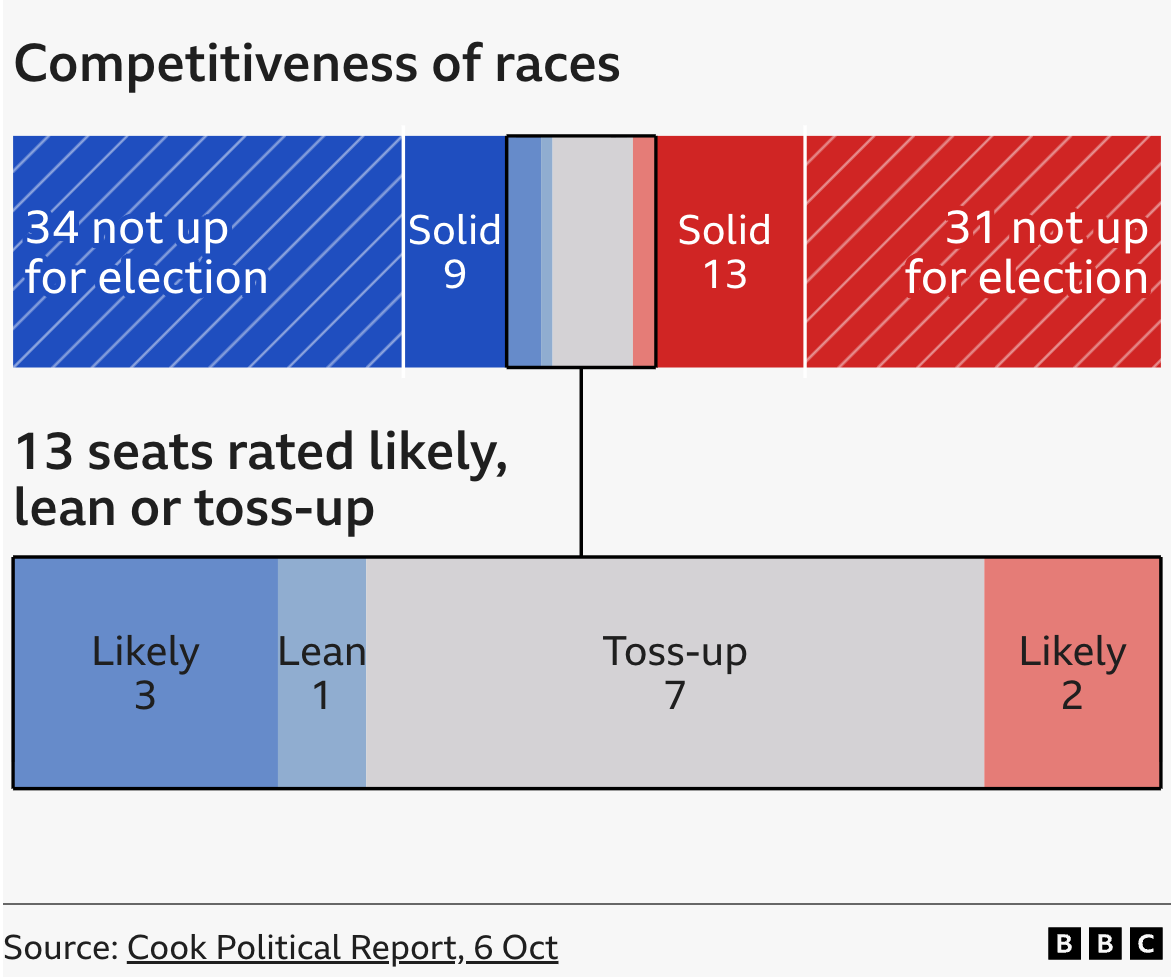
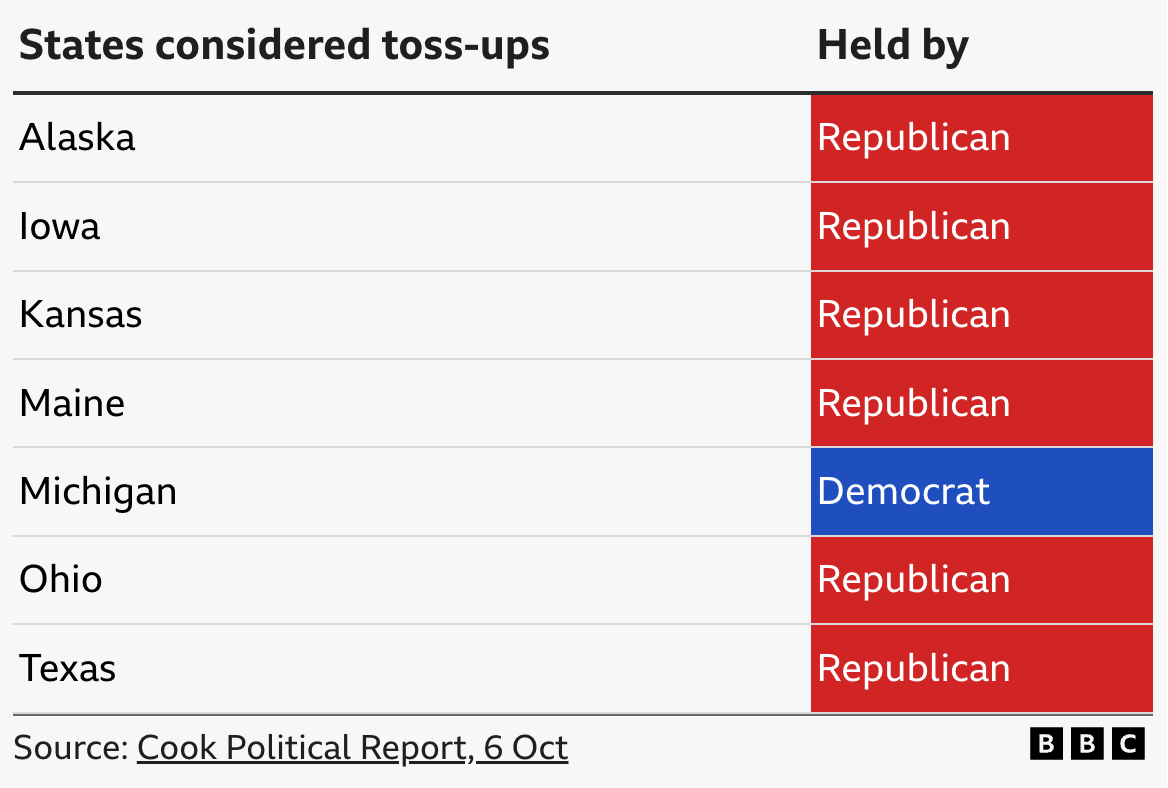
Thirty-five seats are up for grabs in November but analysis by the Cook Political Report suggests that only seven of them are toss-ups that could go either way.

Competitiveness of races

Of those toss-ups, six are currently held by Republicans and one by Democrats. The Democrats would need to win four of those seats, plus the four classed as likely or leaning Democratic, to hit 51 and take control of the Senate.

States considered toss-ups

But winning a majority is no easy task for the Democrats.

They need to keep hold of their seat in Michigan, where polls suggest the race is tighter than Democrats would like between Abdul El-Sayed, a left-wing political outsider, and his Republican rival Mike Rogers, a Trump ally and former FBI agent.

And they would also need to pick up seats in states that Trump won by double-digits in 2024, including Alaska, Iowa and Ohio.

But polls suggest they have a chance, even in Texas where former teacher James Talarico could become the first Democrat to win a Senate seat in the state since 1988 if he defeats Ken Paxton, the current state attorney general and close Trump ally.

Purple banner reading "US Midterm Elections 2026" alongside a stylised image of the US Capitol and white stars.
[BBC]

Trump pledged to "end inflation and make America affordable again" in his 2024 election campaign but the cost of living crisis is proving to be the key issue for voters.

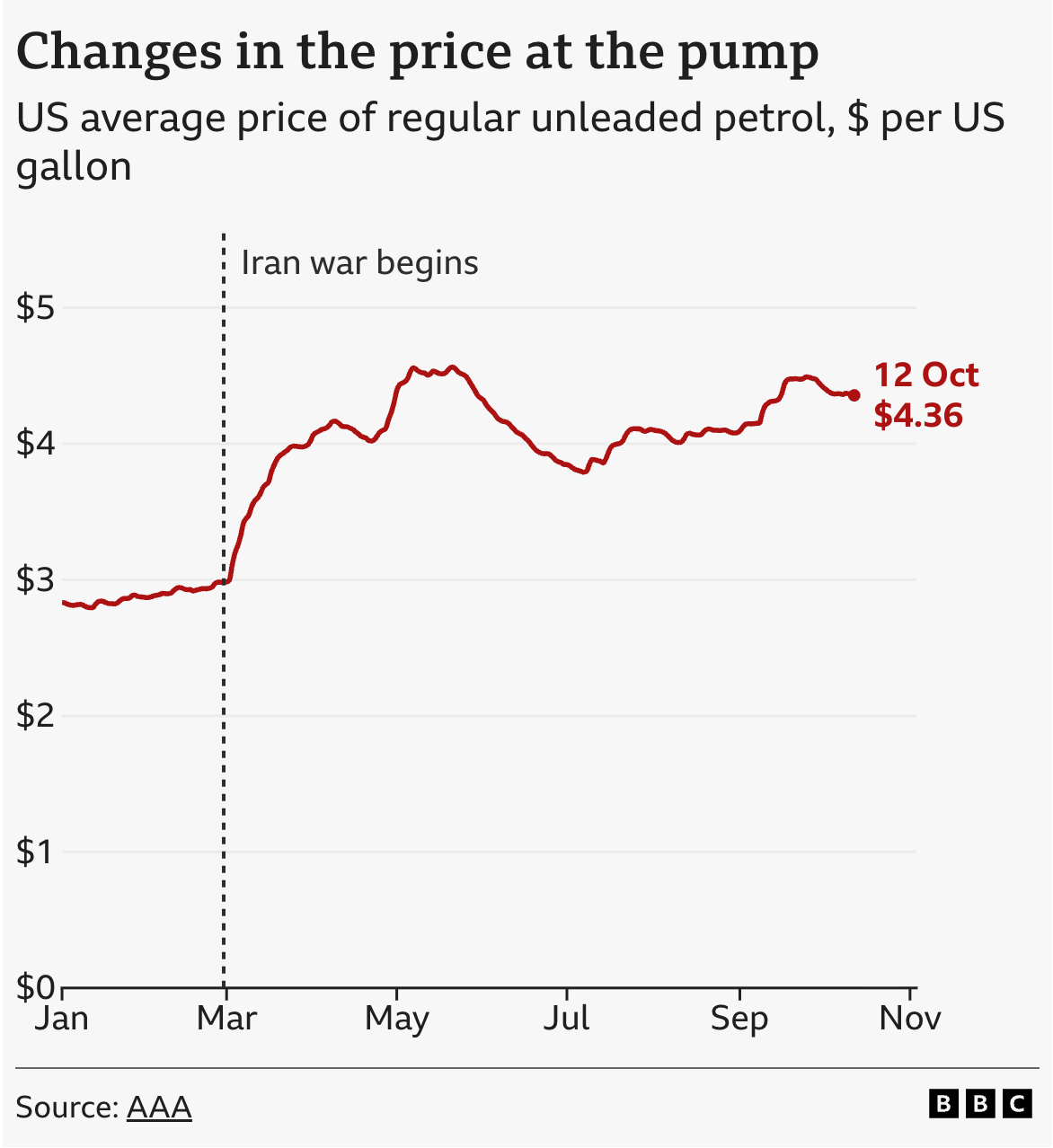
The president proudly declared that gas was "now below $2.30 [£1.74] a gallon in most states" in his State of the Union address on 24 February. But the war with Iran began four days later, disrupting Middle Eastern energy supplies and causing gas to hit $4 (£3.03) in the US.

Changes in the price at the pump

The war became increasingly unpopular as its consequences reverberated around the world and ultimately hit American consumers in the pocket. One poll carried out in August found 63% of respondents disapproved of Trump's handling of the situation.

Other issues that voters say are important to them include healthcare and immigration.

Trump has recently touted his policies around immigration as a big success, citing significantly lower border-crossing figures than in recent years.

Many Democratic candidates are focusing on the high costs of US health insurance and the impact of Trump's legislation on access to the healthcare system.

Most signs point towards a successful midterms for the Democrats, but it wouldn't be the first time that Trump and his party have outperformed polls if they do win more seats than expected.

One of the few things in their favour is their huge financial advantage.

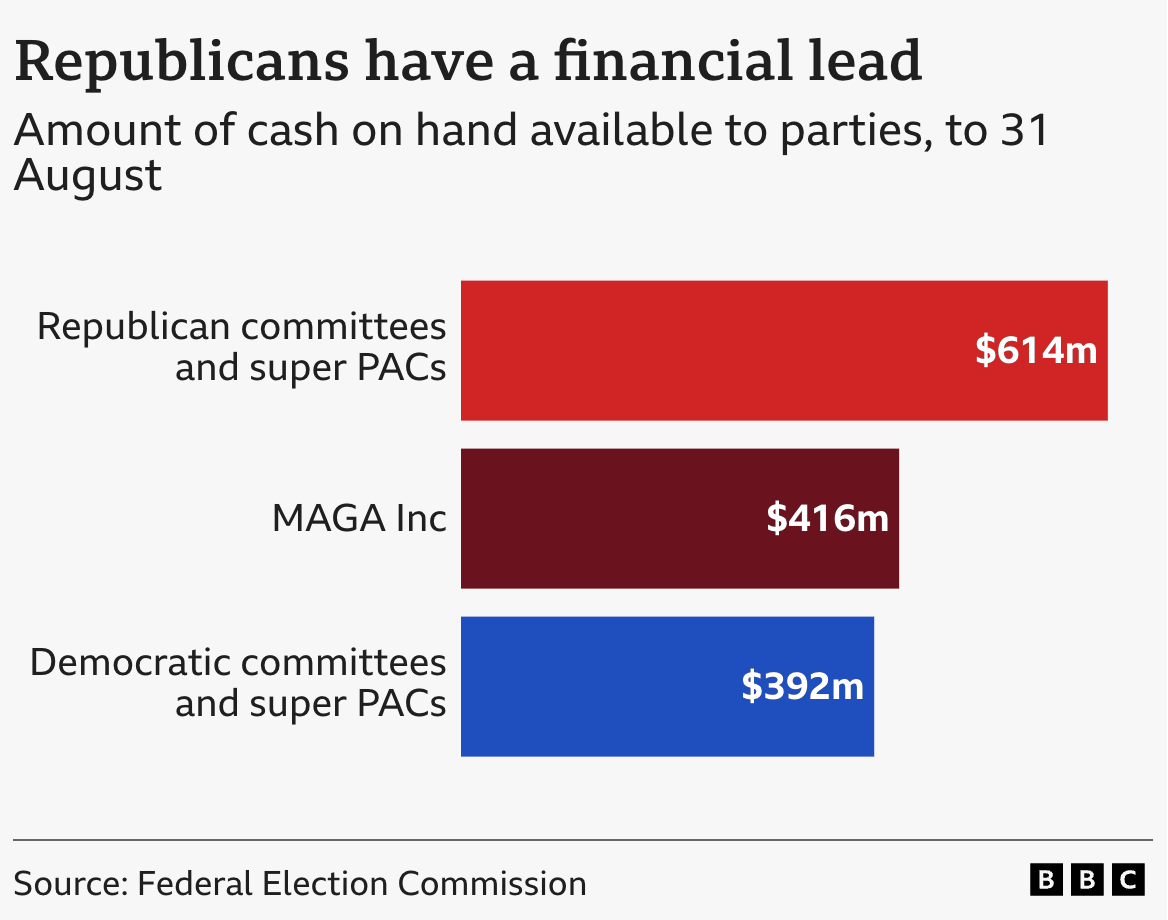
At the end of August, the Republican National Committee and its allied groups had more than $600m (£455m) cash on hand, while the Democrats had just under $400m (£303m).

On top of that, the Republicans also had more than $400m held by Trump's MAGA Inc group, the main fundraising and spending arm of the "Make America Great Again" political movement.

Republicans have a financial lead

The Republicans are using that financial advantage to buy advertising.

More than $1bn worth of political ads were broadcast to US voters in September, according to research firm AdImpact. Republicans spent $200m more than the Democrats and outspent them in nearly all of the Senate races classed as toss-ups.

Trump will be hoping this late messaging blitz can help convince Republicans to get out and vote in November, boosting turnout and limiting the damage done to him and his party.

Whatever the result, attention will quickly turn to the next presidential election in 2028. Trump's unpopularity has dominated the midterms, but with him constitutionally unable to run for a third term the focus will shift to what the Democrats stand for, not just what they stand against.

A thin, grey banner promoting the US Politics Unspun newsletter. On the right, there is an image of North America correspondent Anthony Zurcher, wearing a blue suit and shirt and grey tie. Behind him is a visualisation of the Capitol Building on vertical red, grey and blue stripes. The banner reads: "The newsletter that cuts through the noise."
[BBC]

Follow the twists and turns of Trump's second term with North America correspondent Anthony Zurcher's US Politics Unspun newsletter. Readers in the UK can sign up here. Those outside the UK can sign up here.

This article originally appeared on BBC at https://www.yahoo.com/news/politics/articles/where-us-midterm-elections-won-050249260.html
Tue, 13 Oct 2026 08:30:14 +0000
   Houthi official warns of 'swift and painful response' if U.S. joins war in Yemen
This screen grab taken from CCTV footage released by the Saudi media ministry shows the moment King Khalid International Airport was hit by a strike (-)

A Houthi official on Monday warned the US it would receive a "painful response" if it entered the war in Yemen, where Saudi Arabia has reportedly requested Washington's help in dealing with the group as it weathers repeated attacks.

Yemen's civil war -- in which a Saudi-led military coalition supports the government against the Iran-backed Houthis -- reignited in July, months into the wider regional conflict that has roiled energy markets and plunged the Middle East into risis.

The Houthis quickly began targeting Saudi oil facilities, tankers and transport hubs, including a string of lethal strikes on Riyadh's airport, rocking the world's top oil exporter.

Blasts resounded over the capital again on Monday night, with the Saudi coalition saying it had intercepted a Houthi missile and the group saying it had again targeted the airport.

Later, the coalition announced that it had intercepted two ballistic missiles in the south of the kingdom, near the border with Yemen.

In a statement posted on X, the coalition said it had "intercepted and destroyed two ballistic missiles launched by the terrorist Houthi militia towards Khamis Mushait", a city where a Saudi military base has previously come under attacks.

Following an attack at the Riyadh airport on Saturday that killed 13 people, US President Donald Trump said he was considering joining Saudi strikes against the group, after having reportedly rebuffed previous requests for help from the kingdom.

"The Houthis are misbehaving very badly. They're misbehaving very badly. No good," Trump said on Monday.

"If the US becomes involved in the aggression against Yemen, we will not deliberate over the decision to respond, rather, there will be a swift and painful response targeting the US and all its interests in the region," Houthi political bureau member Mohammed Al Bukhaiti told AFP in an interview.

He also warned "all employees and workers at Saudi oil facilities and airports to stay away from these sites, as they have become legitimate targets".

Saturday's strike on King Khalid International Airport was the deadliest attack on Saudi soil in more than a decade, and also left hundreds wounded.

Trump said the attack was "not acceptable" and that he would be speaking to the kingdom's de facto leader Crown Prince Mohammed bin Salman, telling reporters the US was "going to look at" the possibility of joining Saudi strikes. 

Operations remained suspended at the sprawling airport on Riyadh's outskirts on Monday.

- 'Serious' response -

Bukhaiti said the purpose of the campaign against Saudi targets was to send a message to the crown prince "that he can no longer wage aggression against Yemen from a safe position".

Saudi energy minister Prince Abdulaziz bin Salman told a conference in Riyadh on Monday that the recent events had "tested our infrastructure, our institutions, our people, and our resilience".

"The events of recent weeks are serious, our response must be equally serious."

CCTV footage of Saturday's attack released by Saudi authorities showed Muslim pilgrims in religious attire waiting in departure lounges before a sudden blast tore through the building and brought down flaming debris.

The atmosphere in Riyadh remained tense on Monday, as state broadcaster Al Ekhbariya said the military coalition was responding to drone and missile threats.

In the evening, mobile phones received a loud government alert warning of a "hostile aerial threat" before the announcement of the interception. 

The alert delayed the kickoff of a football match between Uzbekistan's Neftchi Fergana and Saudi team Al Nassr, home to Portuguese superstar Cristiano Ronaldo.

It was the first use of the phone alert system in Riyadh in weeks, with no official reason given for the lack of messaging during the attacks targeting the capital in recent days. 

The Houthis said they had also targeted the Khamis Mushait base in the kingdom's south with a drone.

- Flights suspended -

The US embassy in Saudi Arabia said US government employees must obtain its authorisation before using any airport in the kingdom, and urged US citizens to "take extreme caution" if they chose to do so.

The mission also said "American citizens have been detained for taking photos of recent events" in Saudi Arabia.

The UAE's national carrier Etihad Airways announced on Monday that it was cancelling all flights to and from Riyadh until next week, and also suspended flights to Dammam and Jeddah.

Bahrain's national carrier Gulf Air said it too was cancelling all Riyadh flights until Saturday.

US operator Delta announced it would delay the launch of direct flights from Atlanta to Riyadh, scheduled for October 23.

Despite vast spending on military hardware, the Houthi attacks on oil, military and transport facilities across the large, mostly desert country are stretching Saudi defences.

Thomas Juneau, security analyst at Ottawa University, said that despite some success, "Saudi Arabia is so large that it's simply impossible for them to consistently defend themselves".

Riyadh leads an international coalition that has supported Yemen's government militarily since 2015, including by seeking to exert control over Yemeni airspace and the airport in the Houthi-held capital Sanaa.

Juneau said the Houthis now "want to do to Saudi Arabia what Saudi Arabia does to them".

The long-running Yemeni civil war has created a deeply entrenched humanitarian crisis in the impoverished country.

UN rights chief Volker Turk said he was "appalled by the repeated attacks" on Saudi Arabia, but urged both sides to back down, adding "continued fighting will only unleash further misery with no end in sight".

burs/ach/pdw

This article originally appeared on AFP at https://www.yahoo.com/news/world/articles/saudi-says-resilience-tested-vows-134140110.html
Mon, 12 Oct 2026 21:45:54 +0000
   Marijuana is on the ballot in 2026. The debate has changed.
Marijuana leaf with the USA flag colors

Voters in Massachusetts, Idaho, and Houston are reconsidering marijuana legalization, who controls it, and how existing laws are enforced.

getty

Ten years after Massachusetts voters legalized recreational marijuana, they’re being asked to reverse course. Meanwhile, voters in Idaho and Houston will weigh in on who gets to decide marijuana policy and how existing laws should be enforced.

The November 3 election offers an interesting snapshot of how the marijuana debate is changing. And for employers, the results could have implications for everything from workplace accommodations to drug testing and criminal background checks.

Massachusetts: Could Legalization Go Into Reverse?

Massachusetts voters approved recreational marijuana in 2016, and the industry has grown considerably since then. In September, the state’s Cannabis Control Commission reported that recreational marijuana businesses had surpassed $10 billion in cumulative sales.

Now, voters are being asked whether to dismantle that market.

Question 8 would eliminate recreational marijuana sales, the associated tax and regulatory framework, and home cultivation. Adults 21 and older could still possess up to one ounce, subject to limits on concentrates, without penalties. Medical marijuana would remain legal.

If approved, the measure would take effect January 1, 2028. Massachusetts would become the first state to repeal a voter-approved recreational marijuana market.

So, why reconsider legalization after a decade?

Supporters point to concerns about youth access, impaired driving, mental health, and the commercialization of cannabis. They argue that the regulated market has brought consequences voters didn’t fully anticipate in 2016.

Opponents warn that eliminating recreational sales could push consumers toward illicit markets, eliminate tax revenue, and threaten businesses and jobs.

It’s a notable shift in a country where marijuana policy has generally moved toward greater legalization. Massachusetts could become a test of whether voters are willing to revisit an established cannabis market.

For businesses operating in that market, the stakes are substantial. Recreational retailers, cultivators, and other operators could face significant disruption, although qualifying businesses could seek medical marijuana licenses.

For other employers, the more immediate question is what happens to existing workplace protections.

Massachusetts legalized medical marijuana in 2012, and its courts have recognized that employees using marijuana to treat qualifying medical conditions may be entitled to reasonable accommodation.

In Barbuto v. Advantage Sales and Marketing, the state’s highest court considered a case involving an employee who was terminated after testing positive for marijuana despite disclosing her medical use. The court concluded that the employer could have an obligation to consider a reasonable accommodation under state disability discrimination law, even though marijuana remained illegal federally.

Employers may still consider safety concerns, undue hardship, and applicable federal requirements. But they generally cannot dismiss an accommodation request simply because it involves medical marijuana.

Because Question 8 would preserve medical marijuana, those considerations would remain relevant regardless of the election outcome.

Idaho: Who Gets To Decide?

While Massachusetts voters reconsider a legalization decision made a decade ago, Idaho voters will decide who gets to make that decision in the future.

House Joint Resolution 4 would amend the state constitution to give the legislature exclusive authority to legalize marijuana, narcotics, and other psychoactive substances. Citizens could no longer use ballot initiatives to legalize those substances.

Idaho currently prohibits both recreational and medical marijuana. Advocates have repeatedly attempted to place medical marijuana legalization before voters, including an initiative that failed to qualify for the 2026 ballot.

Supporters of HJR 4 believe legalization decisions should go through the legislative process, where lawmakers can conduct hearings and evaluate proposed regulations. Opponents argue that the amendment would unnecessarily restrict voters’ ability to change state law.

For employers, the immediate impact would be limited. Idaho’s marijuana prohibitions and existing workplace drug-testing requirements would remain unchanged.

Under Idaho Code § 72-1705, employers seeking the protections of the state’s Employer Alcohol and Drug-Free Workplace Act generally must maintain a written testing policy. The policy must identify the types of testing conducted, be communicated to affected employees and available to applicants, and explain that violations may result in termination for misconduct. The statute also recognizes an exception for qualifying collectively bargained policies.

Those requirements would remain in place regardless of the election outcome.

The longer-term significance is how Idaho’s marijuana laws could evolve. In states where voters have approved legalization through ballot initiatives, those changes have sometimes prompted additional debates about drug testing, medical marijuana, and off-duty conduct.

Idaho voters will decide whether that path remains available.

Houston: Changing Enforcement Without Legalization

Houston voters will consider another approach to marijuana policy: making enforcement of certain marijuana offenses a lower priority for local police.

Proposition A would make enforcement of Class A and Class B misdemeanor marijuana possession the Houston Police Department’s lowest law enforcement priority. It would also establish reporting requirements and prohibit no-knock search warrants by Houston police officers.

Marijuana possession would remain illegal under Texas law.

Texas does have a limited medical cannabis program. Its Compassionate Use Program allows qualifying patients to obtain prescribed low-THC cannabis for certain medical conditions. The state expanded that program in 2025, but Houston’s proposal wouldn’t change it.

For employers, the most relevant consideration may be criminal background screening.

If police make marijuana possession a lower enforcement priority, fewer arrests and prosecutions could follow. Over time, that could influence the marijuana-related records employers encounter when screening applicants.

But Proposition A wouldn’t erase existing convictions or change the legal standards governing employment decisions based on criminal history.

Employers would still need to follow applicable federal, state, and local requirements, including the Fair Credit Reporting Act when obtaining employment background reports from consumer reporting agencies.

Houston’s proposal illustrates how marijuana policy can change at the local level, even when the underlying state criminal law remains the same.

What Happens After Election Day?

Massachusetts could eliminate recreational sales while preserving medical marijuana accommodations. Idaho could restrict future citizen-led legalization efforts without changing its drug-testing laws. Houston could reduce enforcement priorities without legalizing marijuana.

Medical marijuana protections may continue even when recreational laws change. A positive drug test may indicate prior exposure without necessarily establishing current impairment. And changes in criminal enforcement may influence background screening without changing the laws governing employment decisions.

Federal requirements also remain important, particularly for employees in safety-sensitive positions subject to Department of Transportation drug-testing rules.

As results come in, employers should focus on what changes, when those changes take effect, and whether existing workplace policies need attention.

Voters will decide what direction marijuana policy takes next. Employers will have to navigate what those decisions mean in the workplace.

This article was originally published on Forbes.com

This article originally appeared on Forbes at https://www.forbes.com/sites/alonzomartinez/2026/10/12/marijuana-is-on-the-ballot-in-2026-the-debate-has-changed/
Mon, 12 Oct 2026 12:00:00 +0000
   Some peptide users report lasting symptoms as RFK Jr. pushes for wider access

After the third day of squirting an experimental drug up his nose, Dylan Meetze felt horrible.

"It was like I was underwater, like it took the most to do anything," he said.

Subscribe to The Post Most newsletter for the most important and interesting stories from The Washington Post.

Meetze stopped taking the drug, but he endured fatigue and anxiety for months afterward, and his eyes and muscles twitched, he said.

He had taken BPC-157, a peptide drug popularized by podcasts about wellness, longevity and what's called "body optimization." Peptide is a general term for substances that are smaller than proteins but composed of the same building blocks. Dozens of peptide drugs, including insulin and GLP-1 weight loss medicines, have garnered approval by the Food and Drug Administration. But BPC-157 and many others have not because they haven't undergone clinical trials.

This fact hasn't stopped online influencers from promoting them as remedies for muscle injuries, gut issues, covid and more. Use of BPC-157 is growing in the United States, particularly among White males, according to a new analysis of millions of de-identified electronic health records. Since 2020, the analysis, which hasn't yet been published in a peer-reviewed journal, found that more than 1,000 people told doctors they had used the drug.

Meetze said he decided to take BPC-157 after listening to Andrew Huberman, a Stanford neuroscientist with more than 16 million followers on YouTube, Instagram and TikTok, who talks up peptides frequently on his podcasts. Studies in mice suggest that BPC-157 helps muscles heal and has "very high safety profiles," Huberman has said, "at least, with respect to the lethal dosing." His guest on one episode, Craig Koniver, a doctor who sells peptides through his wellness clinic, called BPC-157 "super safe" and recommended it for "anyone who's working out on a regular basis." Koniver did not respond to requests for comment.

Huberman didn't respond to multiple queries from KFF Health News, but an automatic reply linked to a disclaimer on his Huberman Lab website that says the podcast doesn't constitute medical advice: "Any reliance on information provided through the podcast is solely at the user's own risk."

Hoping BPC-157 might help him advance as a weightlifter, Meetze said he bought the drug last year from an online vendor, Researchem. A chemical supply company with that name sells experimental peptides through its website, warning that the substances are "solely for laboratory research" and are "not intended for human consumption." (It lists an address in Hillsboro, Oregon, that corresponds to a shared office space. A receptionist at the space said Researchem wasn't registered there, and multiple queries from KFF Health News to the email address listed on the website went unanswered.)

Companies are required to warn that experimental peptides, which haven't been approved by the FDA, are for research use only. But many companies may soon be permitted to drop the warning because of a push by Health Secretary Robert F. Kennedy Jr. to lower barriers to their use. He and other leaders of the Make America Healthy Again movement have promoted peptides as a way to improve the country's health.

On X, before he took the helm at the Department of Health and Human Services, Kennedy vowed to end the "aggressive suppression" of "peptides, stem cells, raw milk" and "anything else that advances human health and can't be patented by Pharma." (In fact, peptides are heavily patented.)

He has repeated the pledge since taking office. On Joe Rogan's podcast early this year, Kennedy said he was a "big fan" of peptides and wanted to make many of them "more accessible." On a podcast with the co-chair of the MAHA Action committee, Gary Brecka, Kennedy said the FDA's role should be to assess science, "but not tell people and not tell physicians what they can and cannot prescribe."

"If you want to take an experimental drug … you ought to be able to do that," he added.

This summer, Kennedy's health department appointed doctors with financial stakes in the peptide industry to a panel that advises the FDA. At an FDA meeting in July, the new appointees voted to ease restrictions on six experimental peptides, including the trendy compounds BPC-157, TB-500 and MOTS-c. They advised adding these peptides to a list, called 503A, that would allow specialized pharmacies to make the drugs for human use, even though the FDA hasn't approved them.

In an email, HHS spokesperson Emily Hilliard wrote that every committee member satisfies the FDA's ethics requirements. "FDA - not podcasts or politics - determines which substances qualify for inclusion on the 503A Bulks List," she wrote. The FDA has yet to issue a final decision.

The vote went against FDA scientists who presented research on the six peptides, concluding there wasn't enough evidence to show that they improved any condition. Furthermore, the scientists highlighted a potential for liver damage, allergic reactions or other serious consequences.

"People are saying this is about medical freedom - putting decisions back in the hands of patients," said Reshma Ramachandran, a regulatory science researcher at Yale School of Medicine. "But what we see in practice is that incentives aren't actually centered around patients. They're centered around selling products."

Scientists also warned that drugmakers would be reluctant to invest millions of dollars into clinical trials on peptides if they could be sold without FDA approval.

"The chances of clinical trials getting done now are diminished," said Eric Topol, executive vice president of Scripps Research, a biomedical science institute in San Diego. "We will have more people who are prey to predators that will sell, sell, sell."

A lack of data leaves consumers in the dark.

Meetze sought help on Reddit, where people post about pain, headaches, vision problems and a lack of motivation after taking experimental peptides. Peptide enthusiasts often comment on these posts with skepticism, attributing a person's problems to contaminated products, preexisting conditions or misuse of the drugs. The online vitriol can be intense, so Meetze welcomed an invitation to join a private group on the social platform Discord, in which people with BPC-157 side effects tried to figure out what happened to them and how to fix it.

"There are millions of success stories with these peptides," Meetze said, "but no one wants to believe that this wrecks some of our lives."

One member of the private side-effects group, a 46-year-old software engineer named Dominik E., said he got an excruciating migraine within days of taking BPC-157 with TB-4, another unapproved peptide - a combination called the "Wolverine stack" because of its purported ability to heal wounds rapidly like its namesake Marvel superhero.

"My left eye started throbbing really badly, and the left side of my face became numb," he told KFF Health News, which agreed to only partially identify him and others interviewed for this article who were concerned about divulging sensitive health information.

After two months of migraines, Dominik said, the pain eased, but his face felt inflamed. "It is a total nightmare," he said.

"I'm afraid how people will judge me," said Lois S., a woman who works at a Michigan elementary school. She hoped BPC-157 and another unapproved peptide, retatrutide, would help with weight loss, but she stopped taking the treatment when she felt pain.

"I sought out this substance from a lab that clearly labeled it not for human use, purchased a syringe, and injected this in my kitchen," she said. "That belies all logic about what a normal person would do."

Peptide proponents argue that shoddy manufacturing - not the peptides - causes harm. Therefore, they say, the FDA must protect the public by allowing doctors to prescribe peptides made for human use by pharmacies that specialize in compounding medicines. Typically, compounding pharmacies manufacture alternatives to FDA-approved drugs: for example, so that a patient can get a liquid version of a drug that the original manufacturer makes only as pills.

Adding unapproved peptides to the FDA's list of compoundable drugs would mark a departure from the list's purpose, said Peter Lurie, a former FDA official who now directs the advocacy group Center for Science in the Public Interest. He said that federal and state oversight for compounding pharmacies is often lax, and the pharmacies have been cited for contamination.

Furthermore, he added, the move would mislead consumers into thinking they're buying drugs backed by clinical trials. People promoting peptides often point to promising laboratory research as evidence. Rats with spinal injuries regained tail mobility after BPC-157 injections, for example, and old mice given the experimental peptide MOTS-c could run longer. On average, however, fewer than 10 percent of substances that show promise in animal studies prove effective in clinical trials.

"A lot of this pseudoscience stuff sounds deeply impressive - inflammation this and telomere that - but at the end of the day, none of it really matters," Lurie said. "You've got to show clinical benefit in humans: Does it work?"

Peptide promoters lean on anecdotes, often without verifiable numbers. In a podcast recorded at the White House, the MAHA influencer Brecka said: "Twenty million people have been prescribed these things without adverse events." His guest on the episode, Brigham Buhler - the co-author of "The Peptide Revolution" and owner of a compounding pharmacy that sells peptides and a clinic, Ways2Well, that prescribes them - told Brecka that none of its 75,000-plus patients had reported adverse events from peptides.

Buhler cited even higher numbers in the movie "MAHA Uncensored," a documentary featuring Kennedy and other leaders of the MAHA movement, and that bears the MAHA trademark. In the segment on peptides, Buhler said, "Having treated literally hundreds of thousands of people through our compounding pharmacy, we've never had a major adverse event."

Topol asks why those boasting success haven't conducted clinical studies. "If influencers and companies really believe these peptides are helping people," Topol said, "then they should put their profits back into rigorous research."

Chris Woodward, a spokesperson for Brecka and his company, the Ultimate Human, said in an email that the health and wellness issues discussed on Brecka's podcast do not constitute medical advice. "Mr. Brecka consistently advises his audience to consult a licensed physician," Woodward wrote. Buhler did not respond to requests for comment.

Not all anecdotes are rosy. At an antiaging conference in July 2025 Las Vegas, two women were rushed to the hospital and intubated after being injected with experimental peptides and vitamins at a booth in the exhibit hall, according to citations that Nevada's state pharmacy board issued against the doctor running the booth and his colleagues for prescribing and administering drugs without a state medical license.

An FDA database for adverse events contains concerning reports. Although the database can't prove that a drug, vaccine or medical device caused harm - the reports are brief, unverified and voluntary - it signals issues worth exploring. A 36-year-old woman was hospitalized in December after taking BPC-157 for weight control and a skin disorder, for example, and a 48-year-old man was hospitalized with a "life-threatening" condition after taking the peptide.

FDA scientists presented some of these reports at the July meeting and flagged worrisome outcomes in animal experiments, such as a 2020 study revealing signs of liver toxicity in rats and dogs injected with BPC-157.

Brian Lee, a liver disease specialist at the University of Southern California, was among the panel's minority who voted against easing restrictions. Without clinical studies, he said, afflictions that take time to develop, like liver damage and cancer, might not be spotted for years: "I think this endorsement can be potentially harmful, and I cannot in good conscience vote yes."

The panel's newcomers disagreed. "I do not believe the FDA made a good case on issues with safety with BPC," said Kris Wusterhausen, founder of an antiaging company in Texas, the Resurge Clinic, which sells a BPC-157 product for $149.

"Once you've seen the effects of BPC," he said, "you can't unsee it."

Deepak Srivastava, president of the Gladstone Institutes in San Francisco, designed a clinical trial two decades ago to see if a peptide he studies, TB-4, could repair tissue after a heart attack. Before enrollment, people volunteering for the study would be screened for early signs of cancer because TB-4 triggers vessel growth and cell migration, which might exacerbate malignant growths. He worries about the FDA panel's vote to ease restrictions on a derivative of TB-4, before such trials have been completed, saying, "You need to have a healthy respect for the fact that drugs can be harmful."

Pinchas Cohen, a peptide researcher at the University of Southern California, was less cautious, saying the FDA buzz might drive investors to fund trials. He's seeking support to bring a peptide his lab identified, MOTS-c, to market. It's "un-ideal" for people to take unproven drugs, Cohen said, but that's what's happening: "The world is changing, and people like me need to accept that this is the new reality and find ways to make it as safe as possible."

In the meantime, people like Meetze resort to podcasts and online forums for advice. His symptoms faded after a year, but he still had spells of feeling "zero emotions."

Peptide users describe this condition as anhedonia. It's come up on Huberman's podcasts.

Huberman occasionally mentions other potential peptide risks, like cancer, sprinkling them into advice on how to take them. Take a 2024 episode with 1.2 million views: "I do not think that BPC-157 is not without its quote-unquote 'side effects,'" Huberman says. He adds, "If you're going to go down this path of taking BPC-157, I would encourage you to take the minimal effective dose, to not simply do it every day, and certainly to not do it continuously, and of course to monitor your other health metrics for anything that could potentially resemble cancer or tumor growth, because obviously stimulating angiogenesis for wound repair sounds like a great thing - recovering and being able to do your workouts or play your sport, or move about more comfortably, of course - a wonderfully attractive thing to do."

"Isn't that what we all want? But obviously not with the trade-off of growing a tumor," he said, before interrupting the discussion to advertise a supplement company sponsoring the show.

KFF Health News is a national newsroom that produces in-depth journalism about health issues and is one of the core operating programs at KFF - the independent source for health policy research, polling, and journalism.

Related Content

This article originally appeared on Washington Post at https://www.yahoo.com/news/science/articles/taken-hyped-unregulated-peptides-regrets-103443715.html

Tue, 13 Oct 2026 10:34:43 +0000
   PHÒNG KHÁM BỆNH BÁC SĨ PHÚC - All Rights Reserved
   Ðịa chỉ: Số 02-Hùng Vương-Phường 2-Tp Cao Lãnh-T. Đồng Tháp
   Điện Thoại: 067.3851720  Fax: 067.3857346 - Di động: 0975.340.586  
  Designed by Tay A Co.,Ltd & drtrantanhieu   
Từ thứ 2 đến thứ 6: Sáng từ 5h30 đến 8h. Trưa từ 10h đến 13h30. Chiều từ 15h00 đến 19h30. Thứ 7 và Chủ nhật: Sáng từ 5h30 đến 13h30. Chiều từ 15h00 đến 19h30. Các ngày Lễ, Tết làm việc như thường lệ.